
Brought to You By:
• Antithesis – verify your system’s correctness without human review or traditional integration tests – and avoid bugs or outages.
• turbopuffer – a vector and full-text search engine built on object storage. It’s fast, cheap, and extremely scalable.
• WorkOS – everything you need to make your app enterprise ready.
—
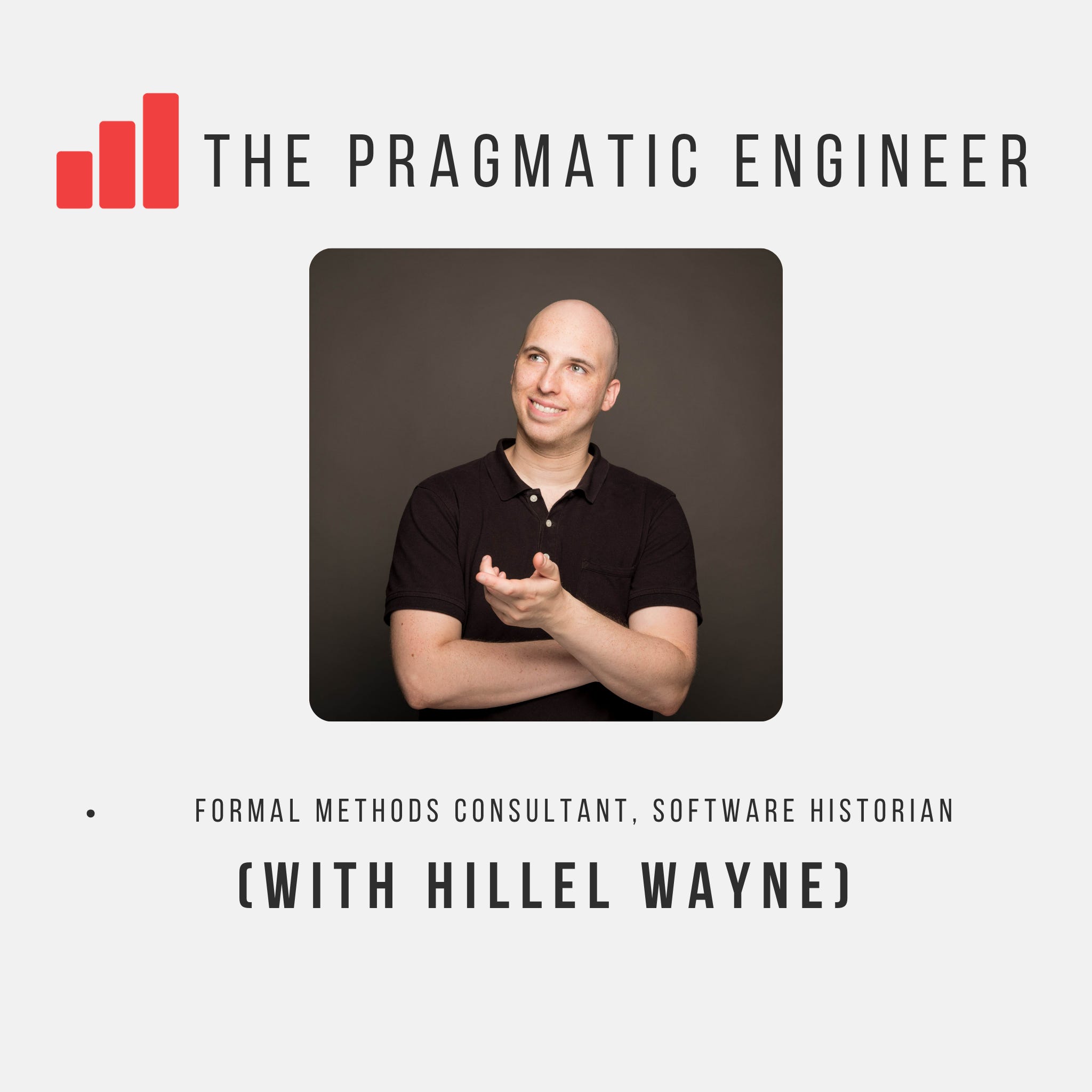
There’s a popular theory that AI will finally make formal verification mainstream because mathematical proof of correctness will be needed when machines write most or all of the code. But will this happen? Today, I’m talking with one of the best people to tackle the prediction. Hillel Wayne is a formal methods consultant, educator, and author, who’s deeply interested in software history.
In this episode of Pragmatic Engineer podcast, I sit down with Hillel to compare software engineering with traditional engineering, discuss where formal methods fit into modern software development, and we explore why they are essential for some of the world's most complex systems. We cover the formal specification language, TLA+, walk through several formal verification tools, examine why distributed systems are so difficult to reason about, and look into whether AI will make formal methods accessible to more engineering teams.
—
Timestamps
Intro
The Crossover Project
What software engineering does better
What traditional engineering does better
Formal methods
TLA+: what it is and demo
TLA+ at Amazon
Ways distributed systems break
Formal methods and systems thinking
The value of learning math
What TLA+ is good for and isn’t
Alloy: a declarative language for software modeling
Other formal methods tools
Property-based testing
AI and the need for formal verification
Logic for programmers
Hillel’s 2025 prediction on AI’s impact
Book recommendation
—
The Pragmatic Engineer deepdives relevant for this episode:
• How to debug large, distributed systems: Antithesis
• How Big Tech does quality assurance (QA)
• Resiliency in distributed systems
—
Production and marketing by https://penname.co/. For inquiries about sponsoring the podcast, email podcast@pragmaticengineer.com.
Get full access to The Pragmatic Engineer at newsletter.pragmaticengineer.com/subscribe
