
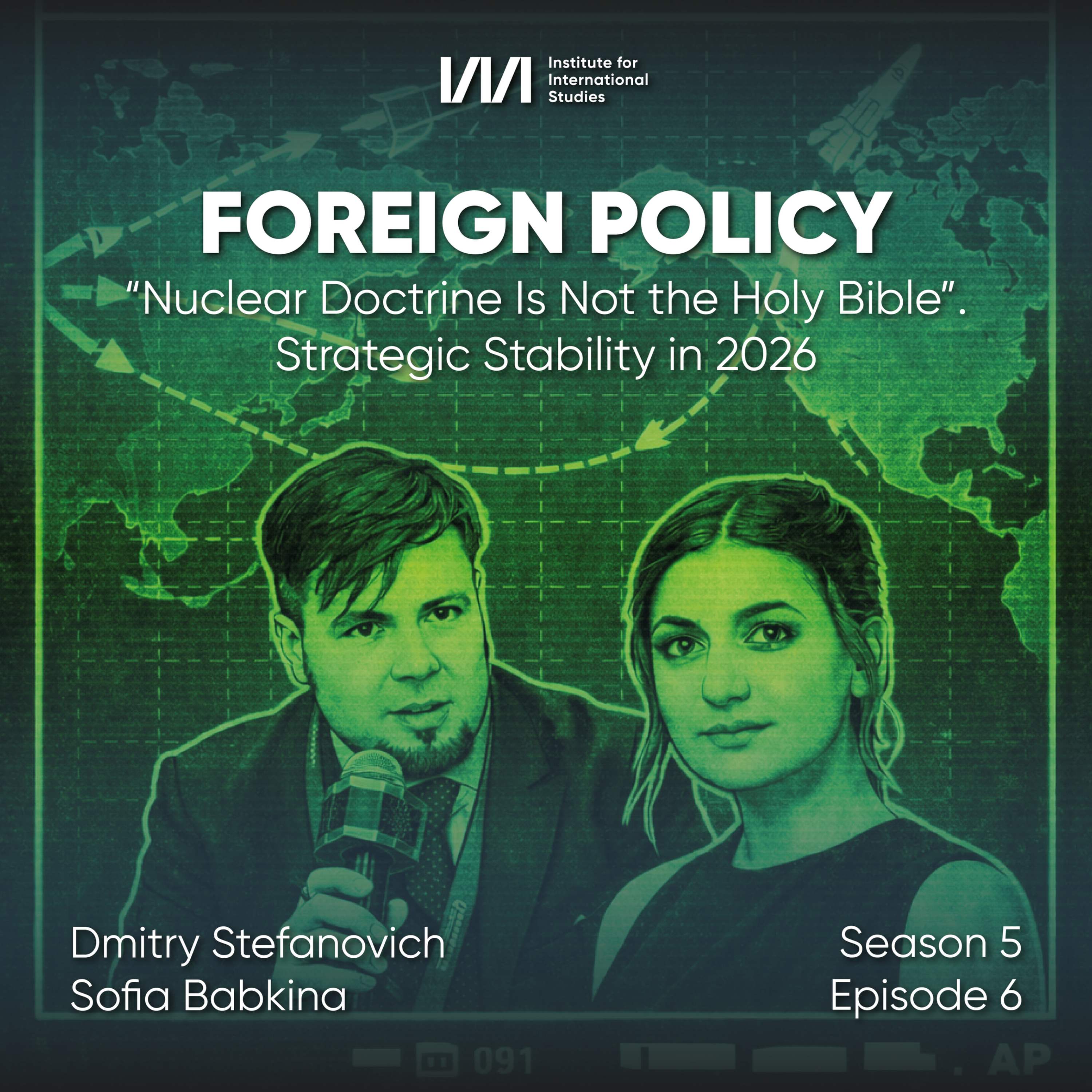
In this episode of “Foreign Policy,” podcast Editor-in-Chief Sofia Babkina speaks with Dmitry Stefanovich (IMEMO RAS) about the changing logic of nuclear deterrence in a multipolar world.
The discussion explores the widening gap between nuclear doctrine and real-world conflict, the implications of recent strikes on nuclear facilities under IAEA safeguards, as well as the future prospects of the NPT regime and the upcoming 2026 RevCon.
Guest: Mr. Dmitry Stefanovich, Research Fellow, IMEMO RAS; Author, “STRATDELA”substack
Host: Ms. Sofia Babkina, Research Fellow, MGIMO Institute for International Studies
Time Stamps:
Intro
Is Nuclear Deterrence Still Working?
Multipolarity and Strategic (In)stability
Russia, the United States and China: Different Nuclear Logics
The Role of Allies in Nuclear Strategy
Strikes on Nuclear Facilities: A Dangerous Precedent
Will More Countries Seek Nuclear Weapons?
Hypersonic Weapons: Ambiguity, Compressed Decision Time and Miscalculation
Non-Strategic Nuclear Weapons and Limited War
Nuclear Weapons, Conventional Power and Missile Defense
Space as a Domain of Strategic Competition
Commercial Satellites and Modern Warfare
The Future of the NPT Regime
NPT RevCon 2026: Can the Treaty Survive?
Q&A
(Mis)perception of Technology That Changed Escalation More Than Expected
Which Region Is Most Dangerous Today?
Underrated Stabilizing Mechanisms
Which Cold War Observations No Longer Apply?
Three Strategic Developments to Watch in 2026
This is the second English-language episode of the “Foreign Policy” podcast. You can listen to the first episode with IAEA Director General Rafael Mariano Grossi by following the link.
The Institute for International Studies (IIS) is a multi-disciplinary research branch of MGIMO University, established in 1976 as the Problem Research Laboratory for System Analysis of International Relations, and last renamed in 2009. We pride ourselves on our history of conducting innovative, in-depth, applied research in IR.
